
The Quiet Systems That Keep Modern Manufacturing Moving
Modern manufacturing depends on quiet systems most people never notice. A reflective look at the invisible infrastructure, thermal control, and disciplined reliability that keep industrial processes moving.
5/8/20268 min read
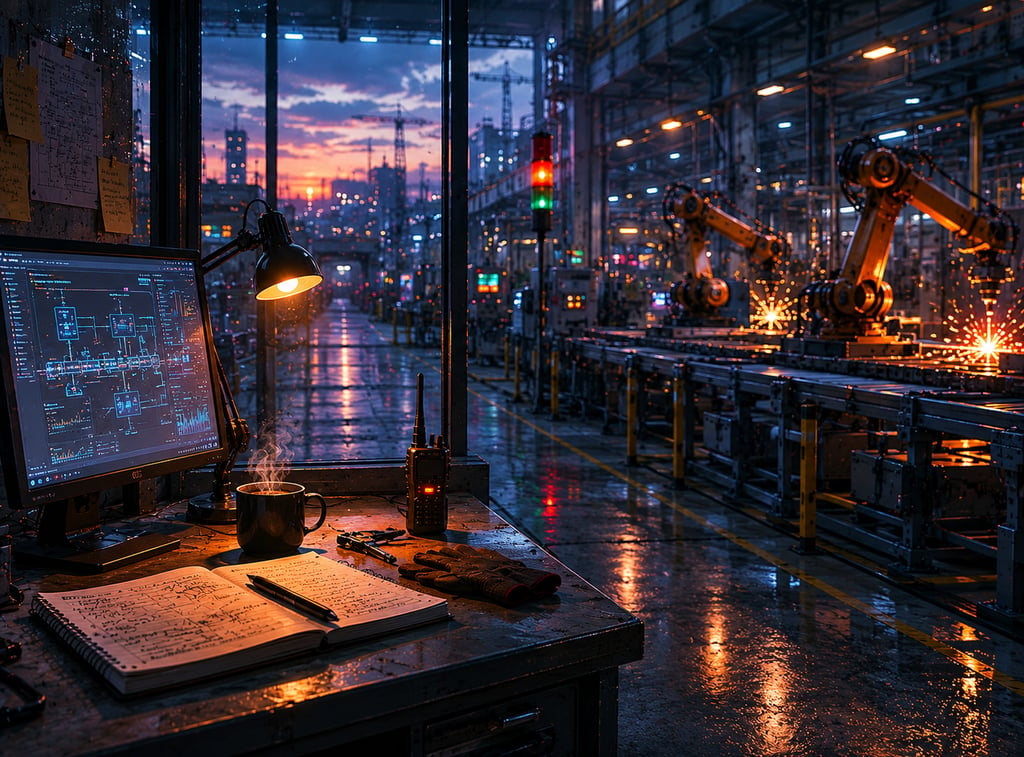
Modern manufacturing looks loud.
That may be the first illusion.
Walk through almost any facility built around production and your senses are immediately recruited. Mechanical rhythm. Conveyor motion. The repetitive choreography of equipment doing exactly what equipment was designed to do. Status lights blinking with practiced indifference. Air that feels processed. Sound that never quite becomes silence.
It feels kinetic.
Fast.
Visible.
Alive in the way systems become alive when enough moving parts agree to keep moving.
But manufacturing is not fundamentally a story about motion.
It is a story about restraint.
That sounds less cinematic.
It’s also closer to the truth.
Movement is the visible layer. Stability is the real product.
A production line that moves quickly but inconsistently is not impressive. It is merely expensive in a more dramatic font.
Consistency is harder to photograph.
Which may explain why we talk about manufacturing the way we do.
We celebrate robotics, automation, efficiency gains, digital transformation, predictive systems, software orchestration, machine intelligence. All deserved, mostly.
But the industrial world still depends heavily on quieter agreements.
Heat staying where it should.
Materials behaving predictably.
Timing remaining disciplined.
Components continuing their thankless negotiations with physics.
The most important systems are often the ones least likely to appear in the story.
Success, in infrastructure, tends to look like boredom.
That is not an insult.
It may be the highest compliment available.
Motion
Software trained many of us to think in visible systems.
Dashboards.
Metrics.
Status indicators.
Logs.
Health checks.
The emotional architecture of modern technical work assumes observability. If something matters, you should be able to inspect it.
Manufacturing participates in that logic now more than ever.
Sensors everywhere.
Process monitoring.
Operational analytics.
Real-time performance visibility.
Digital twins.
Control layers abstracting physical complexity into human-readable confidence.
This is extraordinary.
And still.
The physical world remains stubbornly less cooperative than software people sometimes expect.
Code tends to fail cleanly.
A process crashes.
An error appears.
A deployment rolls back.
Matter prefers ambiguity.
Components drift.
Thermal behavior changes incrementally.
Materials become less predictable.
Performance degrades without dramatic permission.
You don’t always get the emotional satisfaction of obvious failure.
Sometimes you get a week of subtle inconsistency and a meeting nobody enjoys.
Physical systems fail more like relationships than like movies.
Gradually.
Heat
Heat is one of those infrastructural realities we simultaneously understand and ignore.
Everyone knows heat matters.
Very few people spend meaningful time thinking about how much.
Heat is not just a byproduct.
It is negotiation.
Every industrial process involving materials, movement, transformation, adhesion, curing, shaping, drying, packaging, forming, or controlled environmental behavior is, in some way, a conversation with thermal reality.
That conversation can be polite.
Or expensive.
Software culture often encourages the illusion that logic drives modern systems.
And logic does matter.
But logic eventually has to express itself through physical mechanisms operating inside environments with inconvenient thermodynamic preferences.
Code can be elegant.
Physics remains blunt.
Matter expands.
Contracts.
Transfers energy.
Behaves differently depending on context.
Punishes wishful thinking.
This is strangely comforting.
There’s honesty in it.
Digital systems can create a sense that complexity is fundamentally abstractable.
Heat reminds you some realities remain gloriously uninterested in abstraction.
Silence
Infrastructure becomes invisible when it succeeds.
This creates a weird reputational problem.
The better a system performs, the less emotionally legible its contribution becomes.
Nobody pauses to admire a process that maintained temperature discipline all quarter.
Nobody celebrates components that quietly continued working within specification.
Nobody tells dramatic stories about the machine that behaved exactly as expected.
Silence is operational success.
Failure gets narrative.
This is true almost everywhere.
Power grids become fascinating during outages.
Air conditioning becomes existential in August.
Payment systems become emotionally significant during transaction failures.
Manufacturing follows the same pattern.
We notice interruption.
Not continuity.
That bias shapes perception.
Visible innovation receives admiration. Quiet reliability receives expectation.
And expectation is often a thankless emotional state.
Drama
Humans are not naturally built to appreciate uneventful excellence.
We like movement.
Conflict.
Breakthroughs.
Resolution.
Theater.
“Everything continued functioning exactly as designed” is operationally wonderful and emotionally forgettable.
That’s part of why modern conversations about industrial systems often over-index toward novelty.
Automation breakthroughs feel exciting.
AI integration feels culturally current.
Optimization narratives are easy to market.
Maintenance discipline is harder to romanticize.
But civilization is less a story about invention than sustained competence.
That sentence sounds slightly grandiose.
I’ll keep it.
Because once you start noticing infrastructure honestly, it becomes difficult not to think in those terms.
The world works because enough deeply unglamorous systems continue behaving predictably.
That is not boring.
It only appears boring from a distance.
Abstraction
Technical people tend to love abstraction.
I say this as someone who understands the appeal.
Abstractions are kindness.
They allow humans to interact with complexity without drowning in implementation detail.
APIs abstract systems.
Interfaces abstract workflows.
Metrics abstract behavior.
Manufacturing increasingly depends on abstraction too.
A process dashboard becomes a proxy for reality.
Operational indicators become emotional reassurance.
Status layers create confidence.
This is useful.
Also dangerous.
Not because abstraction is bad.
Because abstraction creates interpretive distance.
A green indicator does not mean full understanding.
A stable graph does not eliminate physical uncertainty.
A healthy dashboard may represent reality accurately.
Or partially.
Or briefly.
The problem is not the abstraction.
The problem is forgetting it is one.
Good abstractions disappear into usability.
That disappearance is both their strength and their trap.
Drift
Physical systems rarely fail in the emotionally satisfying ways fiction prefers.
No countdown clock.
No sparks.
No cinematic collapse.
Just drift.
Performance becomes slightly less stable.
Thermal consistency narrows.
Output variation becomes subtly more annoying.
Tolerance begins negotiating.
Maintenance gets delayed because nothing feels urgent enough.
Humans are remarkably tolerant of gradual degradation.
That observation applies disturbingly well beyond industrial settings.
But here it matters operationally.
Gradual decline creates interpretive ambiguity.
Is this normal variance?
Environmental fluctuation?
Material inconsistency?
Component wear?
Process drift?
Operator influence?
A random anomaly?
Judgment becomes harder when failure behaves politely.
And polite failure is often the expensive kind.
Precision
We talk about precision as though it were purely measurement.
Decimals.
Tolerances.
Specifications.
Acceptable ranges.
These matter.
But precision is not fundamentally numeric.
It is environmental discipline expressed numerically.
Stable output depends on stable conditions.
Controlled variables.
Repeatable energy behavior.
Material predictability.
Mechanical consistency.
Temporal discipline.
Precision is less about exactness than about successfully negotiating uncertainty at scale.
That feels less elegant.
Also more accurate.
The measurement is merely the visible receipt.
The real work happens earlier.
Quieter.
Upstream from whatever eventually gets inspected.
Friction
Software culture developed an understandable intolerance for friction.
Interfaces should be seamless.
Systems should be fast.
Experiences should feel intuitive.
Manufacturing offers a healthier relationship with inconvenience.
Matter is not particularly interested in user experience.
Physical systems negotiate with wear, energy transfer, tolerance constraints, timing dependencies, environmental conditions, and material behavior that refuse software-style idealism.
This is oddly refreshing.
Reality remains gloriously indifferent to branding language.
No amount of strategic optimism changes thermal transfer behavior.
No motivational slide deck improves material consistency.
Physics does not care how strongly the quarterly goals were worded.
There is honesty in constraint.
Middle Layers
Some technologies attract admiration.
Others disappear into infrastructure.
The second category is usually more important than it looks.
Modern systems depend heavily on middle layers.
Not the glamorous front end.
Not the catastrophic failure points.
The quiet infrastructure in between.
The components that rarely become part of public storytelling but quietly determine whether continuity remains possible.
Thermal control belongs here.
Not because it lacks sophistication.
Because sophistication becomes visually boring when stabilized.
Specialized industrial heating infrastructure, including the kinds of strip heating systems represented by companies like Thermal Corp, exists inside this strange category of deeply consequential technologies whose highest achievement is becoming operationally forgettable.
Which is not how most humans naturally measure significance.
Maintenance
Maintenance has terrible branding.
Innovation sounds hopeful.
Maintenance sounds obligatory.
One implies possibility.
The other implies calendars.
Yet a shocking amount of civilization depends less on invention than on people taking repetitive preventative work seriously enough to avoid visible collapse.
Maintenance is infrastructure’s quiet moral philosophy.
Attend to small things before they become large things.
Respect wear.
Assume entropy.
Plan around degradation instead of being emotionally surprised by it.
This is not glamorous.
Neither is adulthood.
There may be a connection.
Organizations reveal surprising truths about themselves through maintenance culture.
What gets postponed?
What gets normalized?
What becomes “good enough”?
Which systems are trusted because they’ve been reliable, and therefore scrutinized less?
Competence can earn neglect.
That is one of reliability’s stranger paradoxes.
Time
Software and manufacturing experience time differently.
Software culture tends to think in releases.
Iterations.
Deployment velocity.
Roadmaps.
Sprints.
Manufacturing adds material time.
Stabilization time.
Thermal response time.
Wear time.
Maintenance interval time.
Degradation time.
Physical systems are not infinitely accelerable simply because organizational ambition prefers urgency.
This creates cultural tension.
Modern business often worships speed.
Physical infrastructure frequently prefers patience.
Not slowness for its own sake.
Disciplined pacing.
The distinction matters.
Impatience can destabilize systems whose reliability depends on respecting process realities.
This is not anti-speed.
It is anti-fantasy.
Scale
Small inconsistencies become loud at scale.
That’s one of industrial reality’s more ruthless truths.
A tiny variation repeated enough times stops being tiny.
Slight drift becomes measurable cost.
Minor thermal inconsistency becomes quality instability.
Negligible inefficiency becomes operational drag.
Scale amplifies consequences without necessarily amplifying visibility.
That asymmetry makes quiet systems economically fascinating.
The least visually dramatic layers can create the largest downstream effects.
Which is a deeply modern systems lesson.
Impact and visibility rarely correlate as neatly as we’d like.
Observation
There is something slightly funny about how much confidence dashboards create.
Not because dashboards are bad.
Because visibility feels emotionally satisfying.
You can see the thing.
Therefore you understand the thing.
This is a persistent technical fantasy.
Observability improves interpretation.
It does not eliminate ambiguity.
Manufacturing reminds you of that quickly.
A metric may describe behavior accurately.
Understanding cause still requires judgment.
Data helps.
Interpretation remains human.
Which is comforting.
And alarming.
Depending on the day.
Reliability
Reliability is one of the least emotionally rewarding forms of excellence.
Because nothing happens.
That is the accomplishment.
No incident.
No disruption.
No surprise.
Just continuity.
Humans struggle to admire this instinctively because our storytelling architecture prefers visible events.
Reliable systems deny narrative gratification.
They simply continue.
And yet continuity is expensive competence.
Stable systems represent accumulated restraint.
Disciplined maintenance.
Environmental management.
Operational maturity.
Respect for invisible dependencies.
Reliability is not the absence of activity.
It is the presence of quiet discipline.
The Programmer Problem
Technical abstraction changes how you think.
You begin expecting interpretability.
Systems legibility.
Clean models.
Rational behavior.
Then physical infrastructure reminds you that reality leaks.
That old engineering phrase survives for a reason.
All abstractions leak.
Manufacturing leaks especially honestly.
Eventually every elegant abstraction terminates in material negotiation.
Heat.
Wear.
Tolerance.
Timing.
Physical context.
There’s something healthy about that.
Humbling, certainly.
Software can create the impression that reality wants to be modeled.
Manufacturing reminds you reality merely tolerates modeling when the assumptions are disciplined enough.
Attention
Attention is finite.
No organization can sustain equal vigilance across all system layers forever.
So triage happens.
Visible risks get scrutiny.
Quietly competent systems become background assumptions.
That is emotionally rational.
Operationally risky.
Because infrastructure often becomes most vulnerable precisely when its historical reliability lowers organizational curiosity.
Trust reduces attention.
Reduced attention can accelerate deterioration.
Competence can create complacency.
It’s an almost cruel dynamic.
The systems you worry about are not always the systems most likely to surprise you.
Meaning
There’s a temptation to frame manufacturing purely as technical choreography.
Machines.
Processes.
Controls.
Infrastructure.
But systems are always cultural too.
What gets respected?
What gets ignored?
What receives investment?
What becomes invisible because it works?
Infrastructure reflects organizational values more clearly than mission statements do.
Quiet systems reveal what an operation truly believes about continuity.
That sounds philosophical for a discussion involving industrial heat.
I regret nothing.
Respect
Maybe this is the larger point.
Modern culture disproportionately celebrates visible intelligence.
Algorithms.
Automation.
Interfaces.
AI layers.
Transformation narratives.
The quieter infrastructure underneath receives less affection.
But the world depends heavily on deeply unsexy competence.
Not glamorous breakthroughs.
Reliable continuity.
Disciplined physical negotiation.
Maintenance cultures.
Components nobody outside relevant ecosystems ever think about.
Infrastructure deserves better emotional vocabulary.
Not hero worship.
Just respect.
Respect for the systems quiet enough to disappear because someone did the boring work well.
The Takeaway
Modern manufacturing moves because thousands of invisible agreements continue holding.
Heat gets managed.
Materials behave.
Processes stabilize.
Components endure.
Maintenance happens.
Constraints get respected.
The visible machinery receives the attention because motion is emotionally legible.
But continuity is usually built somewhere quieter.
We notice infrastructure when it fails.
That’s understandable.
Still.
Some of the most intelligent systems in modern life are the ones disciplined enough to avoid becoming stories at all.