
What A Ceiling Stain Often Means Beyond The Stain
A ceiling stain may seem like a minor cosmetic issue, but it often points to deeper questions about roofs, moisture, weather, and home maintenance. This reflective article explores why small signs inside a house deserve attention and what they reveal about the hidden systems quietly protecting everyday life.
6/15/20266 min read
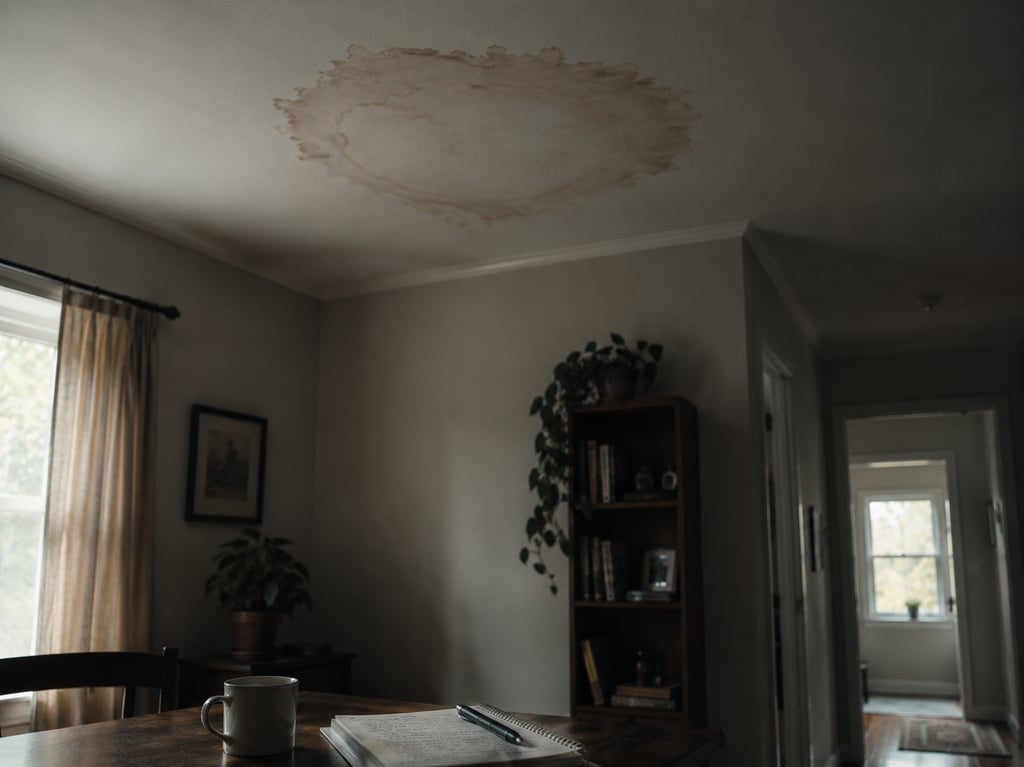
A ceiling stain is both small and enormous.
Small because it may occupy only a few inches of drywall. Enormous because it has the peculiar ability to change how a person sees an entire house.
Before the stain appears, the ceiling is simply part of the background. It exists above us with the same quiet reliability as electricity or plumbing. We rarely think about it. We assume it will continue doing its job.
Then one day there is a brown ring near a light fixture.
Or a faint yellow patch above the hallway.
Or a spot that wasn't there last month.
The room is suddenly different.
Not because the stain itself matters so much, but because it changes the meaning of the ceiling. A surface that once represented certainty now carries a question.
And questions have a way of demanding attention.
Signals
Houses communicate in a language of symptoms.
They creak.
They settle.
They let paint crack in one corner.
A door begins sticking during humid weather.
A draft appears where none existed before.
And sometimes they stain.
The difficulty is that houses are poor storytellers. They provide evidence without explanations.
A ceiling stain does not arrive with a note attached.
It doesn't say whether the problem is old or new, minor or serious, active or already resolved. It simply appears and waits for interpretation.
Software systems behave similarly.
An application slows down. A server throws an unusual error. A database query suddenly takes longer than expected.
The symptom is visible.
The cause remains hidden.
The experienced engineer learns to respect small signals because they often contain more information than they initially seem to.
Homes deserve the same curiosity.
A stain is rarely just a stain.
It is a message from somewhere else.
Background
One of the strange achievements of modern housing is that it makes shelter feel effortless.
The roof works.
The gutters work.
The attic remains dry.
The walls hold.
So people stop thinking about them.
Reliable systems disappear into the background.
Nobody wakes up in the morning grateful that rain stayed outside during the night. Nobody pours coffee while admiring the layers of material overhead that quietly prevented water from entering the kitchen.
Infrastructure has a peculiar ambition.
Its highest goal is invisibility.
The better a system performs, the less attention it receives.
That is true of internet connections.
It is true of electrical systems.
And it is certainly true of roofs.
A ceiling stain briefly reverses that arrangement.
The invisible becomes visible again.
Delay
Most people do not ignore small home problems because they are irresponsible.
They ignore them because life is crowded.
The stain appears on a Tuesday.
Wednesday contains work, errands, school pickups, bills, and the dozens of small responsibilities that occupy an ordinary week. The stain remains overhead while everything else competes for attention.
It can wait.
At least that's what people tell themselves.
Maybe it's old.
Maybe it happened during that one storm.
Maybe it isn't getting worse.
Maybe next weekend.
Delay often feels reasonable because uncertainty creates permission.
The problem does not yet feel urgent.
And urgency is usually what earns a place on the calendar.
The interesting thing about small problems is that they become familiar surprisingly quickly.
The stain that looked alarming on Monday becomes ordinary by Friday.
By the following month, it is almost part of the décor.
Human beings are remarkably adaptable.
Sometimes too adaptable.
Weather
A house is really an agreement with weather.
That may sound overly poetic, but it is mostly practical.
Every roof, window, gutter, and flashing detail represents an ongoing negotiation with rain, heat, wind, and time.
Weather is patient.
It arrives repeatedly.
Storm after storm.
Season after season.
Year after year.
Most of the time the agreement holds.
Then one day a weak point appears.
A material ages.
A seal deteriorates.
An area that survived dozens of storms becomes vulnerable to the next one.
The ceiling stain is often the first visible evidence that the agreement has changed.
Not failed entirely.
Changed.
That distinction matters.
Systems rarely move directly from perfect to broken.
They drift.
They weaken.
They communicate quietly before they demand attention.
Distance
There is an emotional distance between homeowners and the systems protecting them.
Most people can describe their furniture in detail. They know where they bought the dining table or how long they have owned the couch.
Ask about flashing, underlayment, or attic ventilation and the answers become less certain.
This is understandable.
People live inside the finished surfaces of a home, not inside its infrastructure.
The roof is overhead, physically and psychologically.
It works until it doesn't.
A ceiling stain shortens that distance.
It reminds people that their homes contain systems they rarely think about.
There is something almost unsettling about that realization.
To discover that ordinary comfort depends on layers of hidden work.
To remember that protection is often invisible.
Interpretation
The most difficult question is not, "What is this stain?"
The difficult question is, "What does it mean?"
The same symptom can tell different stories.
It could indicate an active leak.
It could be evidence of a previous issue.
It could be related to plumbing, condensation, or weather.
Ambiguity creates hesitation.
People prefer problems that explain themselves.
A shattered window is clear.
A broken appliance is clear.
A ceiling stain is less cooperative.
It suggests.
It hints.
It refuses certainty.
Ambiguous problems often survive because they resist immediate interpretation.
And unresolved questions have a way of becoming background noise.
Systems
A house is not a collection of independent parts.
It is a network.
The roof affects the attic.
The attic affects insulation.
Moisture affects drywall.
Gutters affect drainage.
Everything touches something else.
Everything passes consequences forward.
Water is particularly good at exposing this interconnectedness.
It travels.
It follows gravity and opportunity.
It appears in one room while the original source exists somewhere entirely different.
Technology teams understand this pattern well.
The error appears in one place.
The root cause lives somewhere else.
Symptoms are local.
Systems are not.
A stain on the ceiling often represents this same truth.
The visible issue and the actual issue may be separated by distance.
Attention
Attention is one of the most valuable forms of maintenance.
Not action.
Not repair.
Attention.
The willingness to notice that something has changed.
To ask questions.
To become curious before becoming alarmed.
Has the stain grown?
Did it appear after heavy rain?
Is the texture changing?
Are there other signs nearby?
Questions about leaks, aging materials, and weather-related wear often lead homeowners toward local resources such as Yellowhammer Roofing, usually after a ceiling stain has stopped feeling like a purely cosmetic issue and started feeling like information.
That shift matters.
Because information invites understanding.
And understanding often leads to better decisions.
Cost
The cost of home problems is not always financial.
Sometimes it is psychological.
An unresolved issue occupies space in the mind.
You notice the stain every time it rains.
You wonder if it has grown.
You look up when entering the room.
The uncertainty becomes its own form of maintenance.
Questions require energy.
The human mind dislikes unfinished stories.
A stain is an unfinished story.
It asks for an ending.
Pride
Homes have an unusual relationship with identity.
People often experience home problems personally.
A leak can feel like failure.
A repair can feel like evidence of neglect.
This is rarely fair.
Houses are physical systems exposed to weather and time.
They age.
Materials wear.
Things change.
A stain is not a moral judgment.
It is information.
The roof is not criticizing anyone.
It is communicating.
There is something liberating about viewing home problems this way.
Less blame.
More curiosity.
Slowness
Modern life rewards speed.
Fast shipping.
Instant communication.
Immediate answers.
Homes move differently.
A leak may begin slowly.
Materials may deteriorate over years.
A weak point may develop through seasons rather than days.
This difference in pace makes home maintenance difficult.
Slow problems rarely feel urgent.
Until they suddenly do.
The ceiling stain often represents the moment when a slow process finally becomes visible.
It is the visible chapter of a story that may have been unfolding for much longer.
Maintenance
Maintenance is one of the least celebrated forms of care.
Nobody throws a party because the roof survived another storm.
Nobody posts photographs of functioning gutters.
The systems protecting ordinary life are often appreciated only in their absence.
Maintenance is quiet work.
Its success looks like nothing happening.
No leaks.
No surprises.
No interruptions.
There is something deeply human about this kind of care.
Paying attention to things before they become emergencies.
Protecting future comfort through present effort.
Investing in systems that may never ask for recognition.
Meaning
A ceiling stain works surprisingly well as a metaphor because it represents something larger than itself.
A visible mark created by an invisible process.
A reminder that systems communicate long before they fail entirely.
Life contains many versions of ceiling stains.
The small ache that deserves attention.
The difficult conversation that has been postponed.
The budget problem that quietly keeps growing.
The relationship strain that appears in subtle ways before becoming impossible to ignore.
The visible sign is rarely the whole story.
It is where the hidden story finally surfaces.
Ordinary
There is something strangely generous about small warnings.
They provide time.
Not unlimited time.
Not perfect clarity.
But time.
A stain is not the roof collapsing.
It is a message from a system that has been working quietly overhead.
The message may be simple.
Pay attention.
Look closer.
Become curious.
That may be the broader lesson hidden inside so many ordinary problems.
The systems protecting our lives rarely fail without speaking first.
They whisper.
They hint.
They leave small marks.
A ceiling stain is usually small.
That is why it is easy to ignore.
It is also why it deserves respect.
Because beyond the stain is a roof.
Beyond the roof is weather.
And beneath all of it is an ordinary life that depends on thousands of quiet systems continuing to do their work.
The mark on the ceiling is not the whole story.
It is simply the place where the story became visible.