
What Unexpected Events Reveal About The Systems We Depend On
Unexpected events often reveal the hidden systems supporting everyday life. From insurance and legal processes to relationships and routines, this reflective article explores how accidents and disruptions expose the invisible infrastructure we depend on and why ordinary stability is built on far more support than we usually realize.
6/12/20266 min read
Life is both fragile and stubborn.
That contradiction sits quietly beneath almost every ordinary day.
We make plans weeks in advance. We schedule meetings for next month. We leave groceries in the refrigerator expecting to eat them tomorrow. We operate with the unspoken belief that the shape of our lives will remain mostly the same from one day to the next.
And most of the time, it does.
Then something unexpected happens.
A car accident. An injury. A difficult phone call. A sudden change that divides life into a before and an after.
The event itself may last only seconds.
The consequences can last much longer.
What often surprises people is not simply the disruption. It is the sudden visibility of things they rarely noticed before: paperwork, relationships, insurance, legal questions, support networks, and practical systems that had quietly existed in the background.
You do not usually notice infrastructure during calm periods.
You notice it when something interrupts normal life.
Assumptions
Most of daily life runs on assumptions.
You assume your body will cooperate.
You assume your plans will unfold more or less as expected.
You assume that if something difficult happens, you'll figure it out when the time comes.
These assumptions are useful.
Without them, ordinary life would become exhausting. You cannot wake up every morning and actively consider every possible problem that could occur. The mind creates shortcuts. It treats stability as the default setting.
A software system behaves similarly.
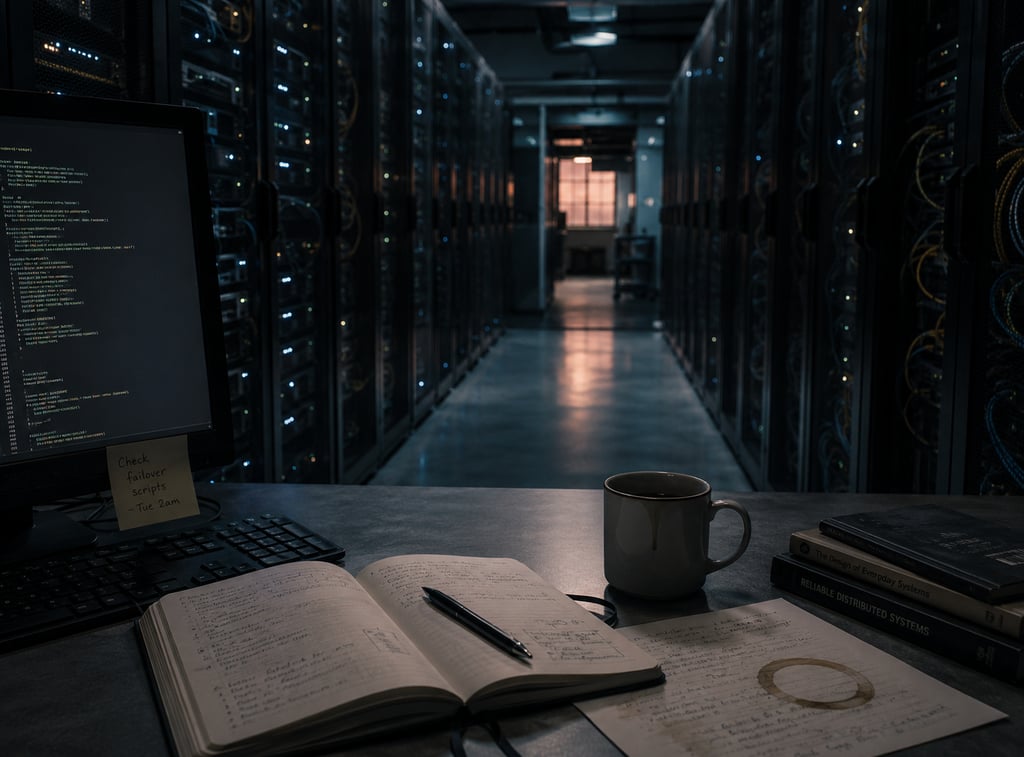
Applications make assumptions constantly. They assume a database will respond. They assume the network connection will remain active. They assume certain conditions will continue existing because they usually do.
Then one assumption fails.
And suddenly the architecture becomes visible.
Life works in much the same way.
Unexpected events often expose the assumptions that were quietly supporting our sense of normalcy.
The Background
Most of the systems that make modern life possible operate in the background.
Electricity.
Roads.
Healthcare.
Insurance.
Legal frameworks.
Family relationships.
Friendships.
Even routines.
These systems become almost invisible because they work so consistently.
Nobody spends the morning appreciating the electrical grid before turning on a lamp. Nobody thinks about emergency contacts while having lunch. Nobody carefully studies insurance paperwork during a perfectly ordinary Tuesday afternoon.
Reliable systems disappear.
That is one of their defining qualities.
Their success lies partly in how little attention they require.
Until they do.
Fragility
There is a paradox at the center of modern life.
We have built systems intended to create stability, yet many of those systems reveal their complexity only during periods of disruption.
Insurance feels abstract until it suddenly becomes necessary.
Medical records seem unimportant until someone needs them.
Support networks appear ordinary until a difficult moment reveals how much they matter.
Preparedness often feels unnecessary right up until the moment it becomes essential.
The systems were always there.
The event simply changed our relationship with them.
Speed
Unexpected events move quickly.
The consequences do not.
A collision may last seconds.
Recovery may take months.
A phone call can change an entire week.
Understanding what that change means may take much longer.
There is a mismatch between the speed of disruption and the pace of adaptation.
Perhaps this is one reason unexpected events feel so disorienting.
The moment itself arrives like lightning.
Everything afterward feels like weather.
The event ends.
The consequences keep unfolding.
Discovery
Disruption has a curious habit of introducing people to systems they never expected to learn about.
Forms.
Procedures.
Documentation.
Processes.
Requirements.
Questions that seemed irrelevant suddenly become urgent.
Many people experience a strange feeling after an unexpected event.
The world appears more complicated than it did before.
Not because the complexity is new.
Because it has finally become visible.
The hidden architecture of everyday life rises into view.
You begin noticing the machinery that had been quietly supporting everything.
Interdependence
Modern culture often celebrates independence.
Self-sufficiency.
Personal responsibility.
The ability to handle things alone.
Yet unexpected events reveal something different.
Most people are supported by countless forms of invisible dependence.
Families.
Communities.
Healthcare systems.
Employers.
Friends.
Institutions.
A person may appear entirely self-sufficient while relying on hundreds of systems they rarely think about.
Stability is often collective.
We simply experience it individually.
Unexpected events remind us of this.
They expose how connected everything really is.
The Administrative Side Of Difficulty
There is another reality that rarely receives much attention.
Hard moments often generate administrative work.
Documents need to be found.
Forms need to be completed.
Questions need answers.
Calls need to be made.
A surprising amount of difficult life events involve logistics.
The emotional experience and the practical experience often happen simultaneously.
You are trying to understand what happened while also learning how systems work.
This can feel overwhelming precisely because the systems were previously invisible.
A person may suddenly find themselves navigating medical questions, insurance concerns, and unfamiliar legal processes all at once.
The disruption is not simply the event itself.
It is the sudden requirement to understand an entirely new landscape.
Questions
Unexpected events generate questions.
Lots of them.
What happens next?
What should I do first?
Who needs to know?
What information matters?
What options exist?
Questions multiply because disruption creates uncertainty.
And uncertainty reveals how much of ordinary life depends on systems we rarely examine.
After serious accidents, for example, people often find themselves trying to understand medical expenses, insurance claims, and legal responsibilities. Situations like these help explain why information from an Athens personal injury lawyer may suddenly become relevant in ways that would have seemed entirely theoretical only days earlier.
The event changes.
The systems do not.
They simply become visible.
Time
Modern technology has conditioned us to expect speed.
Fast deliveries.
Instant communication.
Immediate access to information.
Human systems often move differently.
Healing takes time.
Paperwork takes time.
Recovery takes time.
Understanding takes time.
Meaning takes time.
This difference in pace can be frustrating.
After an unexpected event, people often want clarity immediately.
Instead, they discover that many important processes unfold slowly.
The world continues moving.
Understanding catches up later.
Attention
Unexpected events reorganize attention.
Things that once felt important become less important.
Things that once seemed ordinary become meaningful.
A routine commute can suddenly feel precious.
An uneventful afternoon can look like a luxury.
An ordinary conversation becomes something worth remembering.
Disruption changes perspective.
Not because it teaches entirely new lessons.
Because it reveals things that were previously hidden by familiarity.
Ordinary life contains extraordinary amounts of support.
Most of the time we simply stop noticing.
Memory
There is another interesting effect.
Unexpected events expose the things we postponed.
Conversations we meant to have.
Documents we meant to organize.
Questions we meant to ask.
Plans we intended to make later.
Human beings are remarkably skilled at assuming there will be more time.
Tomorrow becomes a storage unit for unresolved tasks.
The trouble with tomorrow is that it occasionally arrives early.
And when it does, postponed decisions often return all at once.
This is not a failure of character.
It is simply part of being human.
We are designed to live in the present.
Unexpected events remind us that the future occasionally has other plans.
Resilience
People often describe resilience as toughness.
That seems incomplete.
Perhaps resilience is really about support.
A bridge is resilient because of its structure.
A city is resilient because of its infrastructure.
A person is resilient because relationships, systems, and resources exist to absorb difficult moments.
Strength is rarely an individual achievement.
It is usually shared architecture.
This realization can be surprisingly comforting.
Very few people navigate difficult experiences entirely alone.
The systems around us matter more than we realize.
Maintenance
Infrastructure requires maintenance.
Relationships require maintenance.
Health requires maintenance.
Communities require maintenance.
The systems supporting ordinary life do not remain strong automatically.
They survive because people continue investing attention in them.
This work is often invisible.
Nobody celebrates the crisis that never happened.
Nobody applauds the difficult situation that became easier because preparation existed.
Prevention is quiet work.
So is maintenance.
Its success often looks like nothing happening at all.
Ordinary
There is something almost beautiful about ordinary days.
Not because they are dramatic.
Because they are supported by an astonishing amount of invisible coordination.
Roads function.
Phones work.
People answer messages.
Plans proceed.
Routines repeat.
The world feels stable because thousands of systems quietly cooperate in the background.
Unexpected events do not create these systems.
They reveal them.
They remind us that ordinary life depends on far more infrastructure than we can see.
And perhaps that is one of the strange gifts hidden inside disruption.
For a brief moment, the invisible becomes visible.
The assumptions become noticeable.
The support structures become tangible.
We remember that our lives have always been held together by countless forms of quiet work.
Then, eventually, life begins to settle again.
The systems fade back into the background.
Ordinary days return.
And once more we move through them, supported by architecture we rarely notice, trusting things we seldom think about, living inside networks of care and coordination that remain mostly unseen.
Until something unexpected reminds us they were there all along.